Astrology Study Book
Lesson 02Venus Retrograde
A study of what happens in the sky, how this cycle has been interpreted, and the questions it opens around desire, value and relationship.
This study book is an editorial research document created for Blame on Mercury. It distinguishes astronomical event data from mythological and astrological interpretation.
01The event
A moment of cyclical change
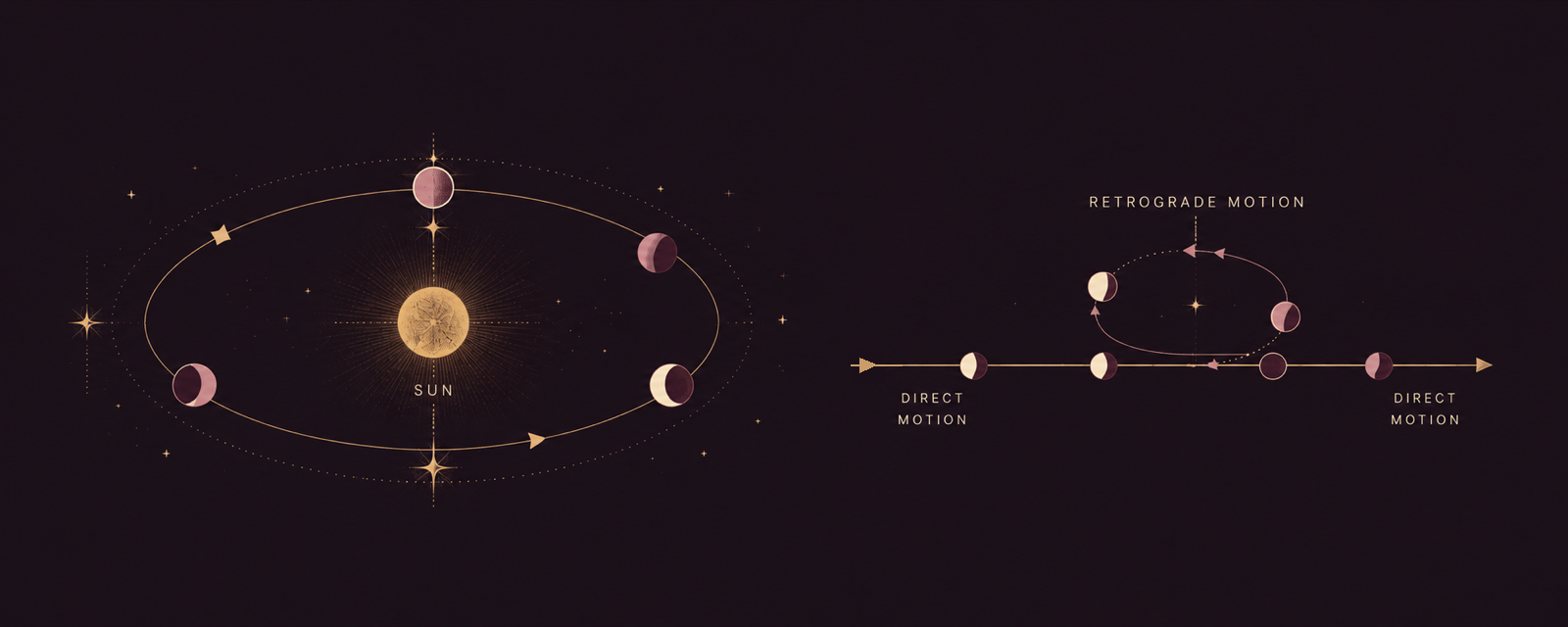
Venus appears to reverse its usual direction against the background sky as seen from Earth. It does not reverse its orbit around the Sun.
This retrograde is part of a larger cycle that includes the inferior conjunction — when Venus passes between Earth and the Sun — and a shift from evening-sky visibility to a morning-sky appearance.
Venus stations retrograde roughly once every 18–19 months — about once per full Venus–Sun cycle. Each retrograde retraces a different stretch of the zodiac.
Timeline · UTC · times approximate
- 3 Oct 2026 · ~07:16
- Venus stations retrograde near 8°29′ Scorpio.
- c. 19–20 Oct 2026
- Venus, moving back through Scorpio, squares Pluto in Aquarius.
- 24 Oct 2026 · ~04:00
- Inferior conjunction of Venus and the Sun (approximate time).
- 25 Oct 2026
- Retrograde Venus returns to Libra.
- 14 Nov 2026 · ~00:27
- Venus stations direct near 22°51′ Libra.
We use tropical zodiac sign labels for Scorpio and Libra — these are not the astronomical constellations. The study book uses UTC throughout; the direct station may appear as 13 November in American time zones. A square is an angle of about 90° between two planets, traditionally read as friction or tension.
02Apparent motion
What does retrograde mean?
Venus continues to orbit the Sun. From our moving viewpoint on Earth, its position against the background sky appears to slow, reverse and later resume its usual direction.
This apparent retrograde motion is distinct from Venus’s axial rotation, which is a separate physical property of the planet.
Retrograde describes an observation from Earth, not a broken or reversed orbit.
03Inferior conjunction
Between Earth and the Sun
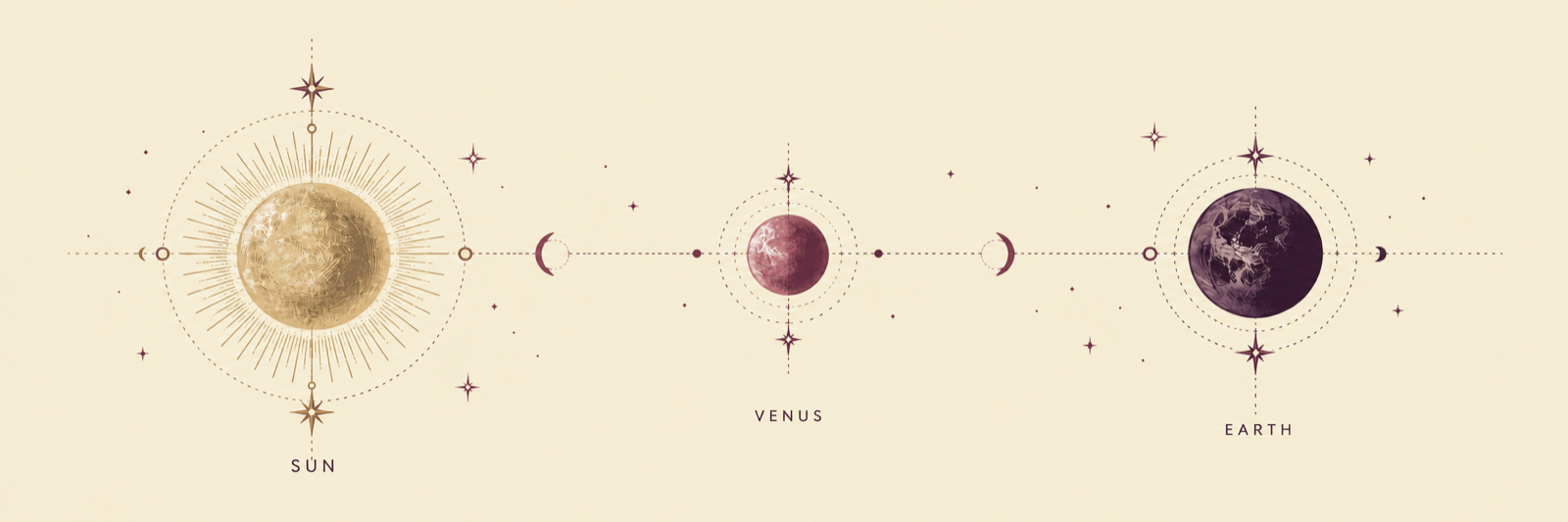
During this retrograde, Venus reaches inferior conjunction. It passes between Earth and the Sun, becoming difficult for most observers to see near the Sun’s glare.
Across this part of the cycle, it changes from an evening-sky appearance to a morning-sky appearance.
In 2026 Venus does not cross the Sun’s disc; a transit of Venus is a different event.
- The geometry
Venus passes between Earth and the Sun.
- The observation
It becomes difficult to see near the Sun and later reappears in the morning sky.
- The interpretation
Astrology may treat this as a symbolic change of phase; that is a symbolic framework, not an astronomical effect on human lives.
- The tradition
When a planet meets the Sun very closely, astrologers call it cazimi, a word traditionally read as “in the heart of the Sun”. Venus meets the Sun at 0°45′ Scorpio on 24 October (UTC), the midpoint of this retrograde, and the moment is often read as a symbolic rebirth of the planet. In longitude, Venus is aligned with the Sun. In the sky, it passes about 6.6° south of it.
Evening star
Visible after sunset — until it fades into the Sun’s glare in the days before the conjunction.
Near the Sun
Lost in the Sun’s glare around the conjunction.
Morning star
Reappears before sunrise, after the conjunction.

04Mythological lens
Inanna/Ishtar and the morning star
In Mesopotamian traditions, Inanna/Ishtar was associated with the planet Venus as both morning and evening star. A myth tells of her descent to the underworld and eventual return.
Her story can be read alongside Venus’s changing visibility as a metaphor — but it remains a metaphor, not a proven explanation of the astronomical cycle. The Mesopotamian figure is historically linked to, but distinct from, the Greek Aphrodite and the Roman Venus — these are separate traditions.
The interpretationIn the astrological tradition, Pluto is associated with the underworld. This retrograde includes a square to Pluto, which makes Inanna’s descent a possible lens: what has to be faced before returning to the surface? A lens, not a proof. Pluto belongs to a modern astrological vocabulary, not to Mesopotamian myth.
05Astrological tradition
Venus does not stop working
In the astrological tradition discussed by Chris Brennan and Nick Dagan Best on The Astrology Podcast, Venus includes desire and its objects, relationships, money, goods, value and the agreements or consensus that people form.
Best proposes reading the retrograde as a shift or intensification in how Venusian themes are expressed, rather than as Venus ceasing to function.
This interpretation belongs to an astrological tradition; it is not an astronomical claim or a universal prediction.
Not a broken Venus. A chance to examine how desire, value and agreement are expressed.

06Scorpio → Libra
From desire to agreement
In the tropical zodiac, the retrograde begins in Scorpio and returns to Libra. Rather than treating the signs as predictions, we can use them as two different sets of questions.
The movement can be expressed through questions rather than definitions — suggestive rather than explanatory, leaving room for the reader to make the connection.
The traditionIn the traditional scheme of dignities, Venus is in detriment in Scorpio, the sign opposite Taurus, one of the signs Venus rules. In Libra, Venus is at home. Read symbolically, the retrograde moves from a sign where Venusian themes meet resistance toward one where they find their natural expression.
Scorpio
Libra
What do I desire?
What have we agreed to?
What does intimacy mean to me?
What does reciprocity mean to us?
What feels intense?
What feels fair?
An interpretation: a question about desire may become a question about agreement.
07Fact / mythology / tradition / interpretation
01
The fact
Apparent retrograde motion, station dates, the inferior conjunction and changing visibility.
02
The mythology
Inanna/Ishtar and the morning and evening star — a Mesopotamian story of descent and return.
03
The tradition
Astrological meanings attributed to Venus and to the signs Scorpio and Libra.
04
The interpretation
Questions we choose to ask through those frameworks — not causal predictions.
08Questions for study
Prompts for study
or journaling
01
When I use the word “value”, do I mean desire, usefulness, money, recognition or something else?
02
What do I want independently of what other people find desirable?
03
Which agreements feel chosen, and which have simply become familiar?
04
What is the difference between intensity and intimacy in the way I use those words?
05
Can a relationship change its terms without one person having to disappear from it?
06
Which strong reactions to others might be telling me something about myself?
07
What would I need to look at first, before reaching for connection?
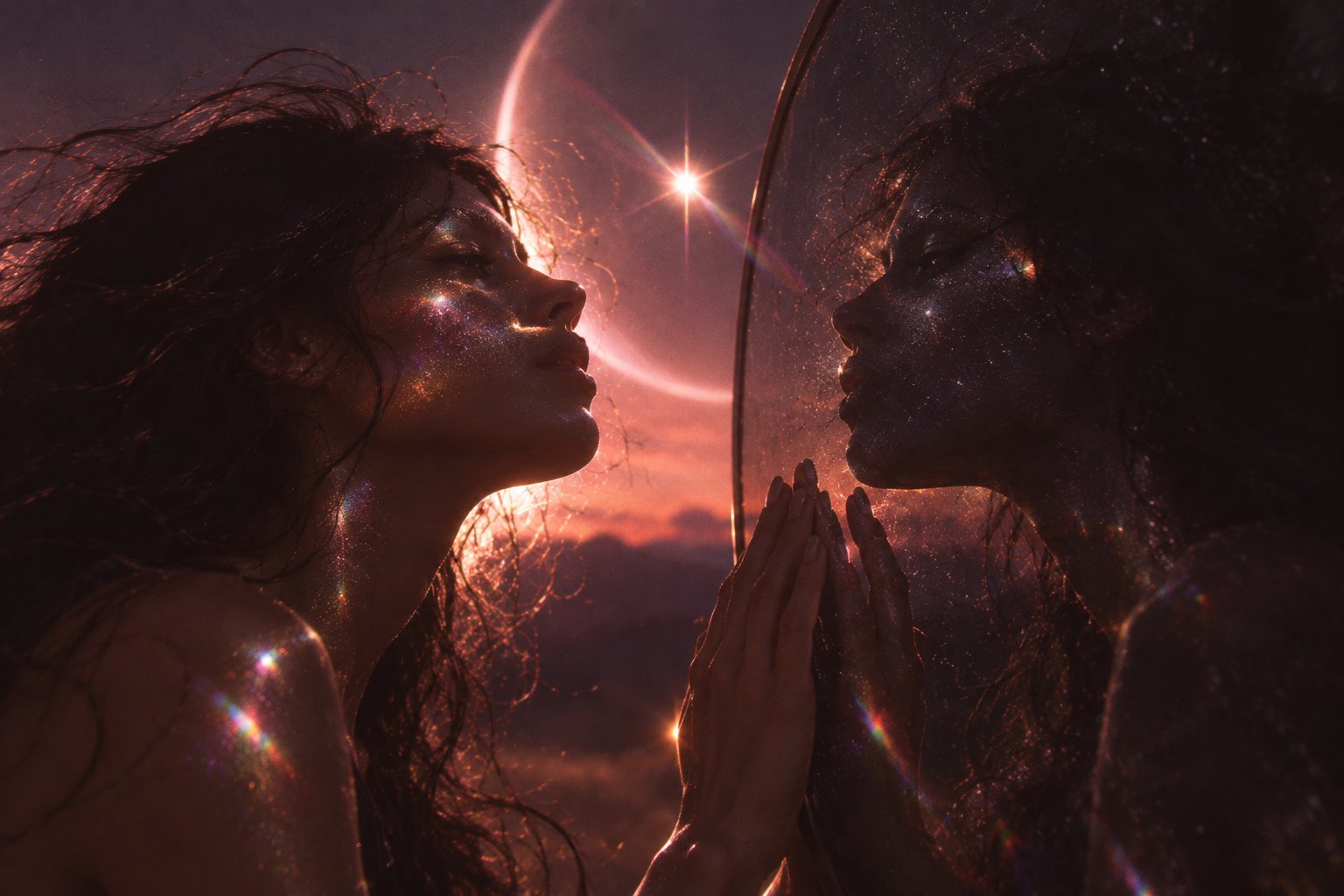
Deep connection begins with accepting the other person whole, shadow included. And that starts with ourselves. Many of the judgements we form about others can be read as a mirror of what happens inside us. I have long believed that if each of us did our own shadow work, the world around us would be a gentler place.
Practical exercise
Where does thisretrograde fallin your chart?
Open the study room with this transit marked on your own natal chart — the arc Venus retraces between 22°51′ Libra and 8°29′ Scorpio, and the natal points it touches. Then write: which houses does it cross, and which agreements does it ask you to revisit?
Works with a saved chart or a new one — your notes are kept when you’re signed in.
09Sources and method
Sources
A selection of astronomical references, historical sources and astrological texts. Interpretive sources are not presented as scientific evidence.
- ESO — Venus' orbit and visibilityOrbital geometry and visibility.
- Astro-Seek — Venus Retrograde 2026Dates, times and tropical degrees.
- EarthSky — Inferior conjunction of VenusGeometry, visibility and the 2026 conjunction.
- ORACC — Inana/IštarMesopotamian deity and astral association.
- The Astrology Podcast — Venus Retrograde: Challenging ConsensusChris Brennan and Nick Dagan Best's astrological interpretation.
- Cafe Astrology — Retrograde Venus enters LibraSign transition and a contemporary astrological reading.
- Cafe Astrology — Venus turns retrograde in ScorpioDignities and the square to Pluto.
- Astro Journal (Jessica Davidson) — Venus Retrograde in Scorpio and Libra 2026Aspects during the retrograde.
- Bonnie Sorsby — October 2026 Astrology ForecastCazimi degree and time.
What this lesson teaches
01
Research →
Start with verifiable event data.
02
Study →
Understand the symbolic astrological framework.
03
Question →
Find a genuine personal question.
04
Interpret →
Use the symbolism as a framework for reflection.
05
Translate
Turn the study into editorial expression.